Yoroido
Memoirs of a GeishaYoroido is Sayuri’s childhood home and the place from which her life as a Kyoto geisha begins. Remembered from far away, it is not a picturesque origin but a small fishing village of limited horizons: its sea cliffs, leaning house, and family traces give the narrative a concrete counterpoint to Gion, while later returns to its images show how departure and memory shape Sayuri’s sense of self.
Setting and the Tipsy House
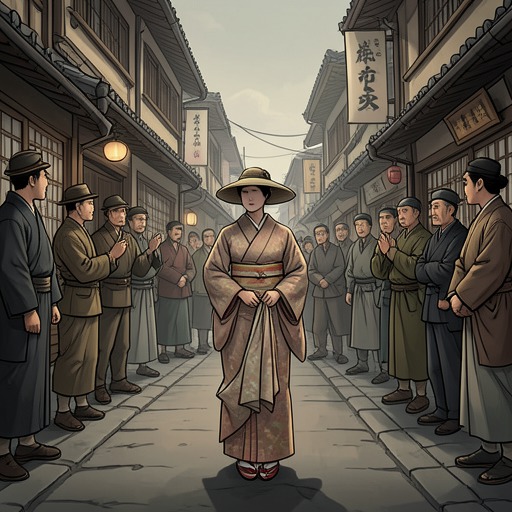
Sayuri is the daughter of a fisherman, born not in Kyoto but in Yoroido, a little town beside the Sea of Japan. The village is remote from the world she will later inhabit as a geisha; few people visit, and, as she recalls it, residents rarely have occasion to leave. Its unglamorous character also contrasts with the public fantasy that she must have been born into a geisha family and trained from infancy. Her remembered beginnings instead lie in a fishing community, in a family home and childhood she has seldom spoken about.
The house stood close to a cliff exposed to the ocean wind. As a child, Sayuri imagined the sea as if it had caught a cold: its wheezing was interrupted by sudden gusts and spray, like sneezes directed at the small building. She thought the house leaned away from the ocean to escape them. Its lopsided appearance had a practical cause as well: her father propped up the eaves with timber taken from a wrecked fishing boat. To Sayuri, the resulting house looked like an old, tipsy man leaning on a crutch. The image gives her childhood home its lasting name, “tipsy house,” and makes its precariousness inseparable from the sea and her father’s labor.
The house also held the family life that Sayuri would later struggle to keep in view. She felt more like her mother than like her father or older sister, and she and her mother shared unusual translucent gray eyes. Village fortune-tellers explained the mother’s pale eyes through an excess of water in her personality, supposedly leaving little room for the other elements. They also described her features as mismatched: her mother’s mouth and father’s angular jaw seemed, in local judgment, poorly combined. These accounts locate the family within village talk and the five-element personality system, while the shared eyes become a specific bond between mother and daughter in Sayuri’s recollection.
Leaving and the Remains of Home
Yoroido is the point of departure for the life that follows. Sayuri’s account identifies her move from the village to Kyoto as part of the story of how she became a geisha, not as the fulfillment of an inherited profession. The distance between the two places later becomes emotional as well as geographical: in Kyoto, daily attention narrows around Gion until she begins to think it is everything, and she works to avoid remembering her sister, parents, and childhood home.
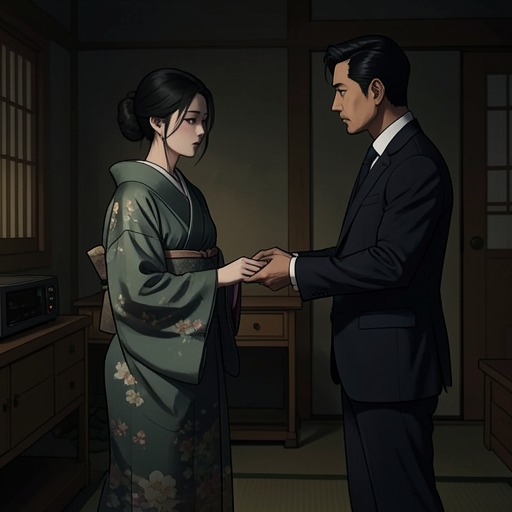
A package from Mr. Tanaka brings that earlier life into the Nitta okiya in the form of the family’s mortuary tablets. Addressed to Sayuri, the parcel is opened by Auntie, who cuts through coarse wrapping and stitched canvas before revealing a dark wooden box. Inside, small tablets that once stood before the altar in the tipsy house lie among white linen. Two bear unfamiliar Buddhist names and appear newer than the rest. Sayuri had hoped the package might somehow free her from the okiya, but the tablets instead return the household’s dead to her and make the village’s past present in the place where she is confined. They are material remnants of home, though what the unfamiliar names signify is not explained in this passage.
Return of Memory
Years later, an invitation to travel from Kyoto to Hakone makes Sayuri conscious of the life she has tried to set aside. On the journey, she recalls another train platform: the day she and her sister were taken from home. Leaving Kyoto’s familiar surroundings interrupts her absorption in Gion, and she recognizes that most people’s lives have little to do with the district that has come to dominate her own. Yoroido returns in this moment not as a destination but as a buried part of her history, along with the family members and earlier self she has tried not to remember.
The village’s landscape also survives in a memory of childhood beside a pond. When a boy named Gisuke climbs too high in a tree and loses his grip, Sayuri runs to find his father, Mr. Yamashita. He reaches the tree just as the boy falls and catches him. The episode becomes a measure for Sayuri’s later understanding of rescue: when she compares herself to Gisuke, she imagines that the Chairman has caught her as she falls. Thus a childhood event in Yoroido is recalled not merely as local anecdote but as a pattern through which she interprets a later relationship.
Place, Loss, and Retrospective Meaning
Yoroido remains a standard against which Sayuri measures both the places she inhabits and the life she has made. As an older woman in New York, she wonders whether returning to the village would seem any less exotic than her surroundings on Park Avenue. The question reverses the assumption that her childhood home is ordinary while New York is strange: distance has made both places capable of appearing unfamiliar, and neither can be restored simply by revisiting it.
In retrospect, Sayuri sees her separation from Yoroido as part of a current that carried her toward the Chairman, while also acknowledging the painful sequence that began when Mr. Tanaka took her from the tipsy house. The village therefore signifies both loss and the beginning of the life she later narrates. Its sea and cliffs belong to her remembered past, but the final image of the world as a wave rising on the ocean places that past within a broader understanding of impermanence: struggles and triumphs alike eventually blur, even as telling the story lets her experience it again.